Lady Grace will be celebrated at a special tour of the Castle on the 8th March 2026 – International Women’s Day.
This tour will focus on her life at Raby and the spaces she helped to create around the Castle.
Click HERE to book tickets.

Lady Grace will be celebrated at a special tour of the Castle on the 8th March 2026 – International Women’s Day.
This tour will focus on her life at Raby and the spaces she helped to create around the Castle.
Click HERE to book tickets.
by Joseph Reed, Archivist
Raby has been home to many remarkable women over the centuries. Some from the Neville family are among the most famous individuals to have ever lived in the castle, such as Cecily Neville (the ‘Rose of Raby’) and her mother Joan Beaufort. Many of those more recent female residents have rightly become more recognised through research over recent years, shared through the ‘Women of Raby’ events: Anne Monson for her pioneering botanical work, Anne Vane (mistress of Frederick, Prince of Wales) for her artistic endeavours, and Catherine, 4th Duchess of Cleveland as an historian and author.
However, this International Women’s Day, Raby will celebrate one woman who has received little limelight: Lady Grace Fitzroy. Recent discoveries in the archives suggest she was largely responsible for saving the castle, and setting it on the course to become the historic home seen and enjoyed today.
Raby’s Fateful Destruction
Lady Grace was born in the highest social circumstances, the granddaughter of a king. Charles II had a son by his famous mistress Barbara Villiers, Duchess of Cleveland. The boy, named Charles (‘Fitzroy’ – meaning ‘king’s son’), was recognised by his father and made Duke of Southampton. Lady Grace was the duke’s eldest surviving child, born in 1697.
Nothing is yet known about Grace’s childhood and younger life. When Grace was a teenager, the Vane family at Raby was enduring a tumultuous time. Though she would not have known it, these circumstances were setting in train the project which would dominate most of her adult life: the destruction (and restoration) of Raby Castle.
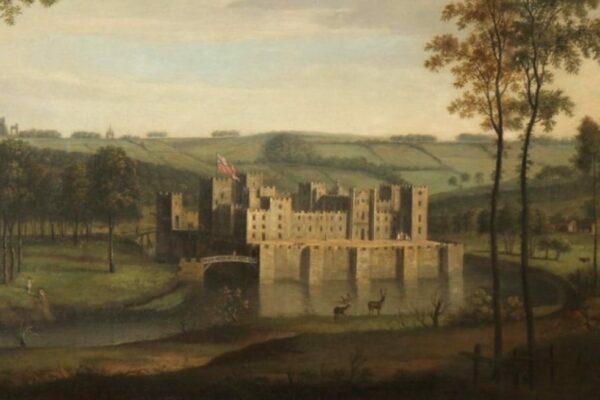
Visitors to Raby today learn about the irreconcilable rift that formed between Christopher, 1st Lord Barnard and his heir Gilbert, which led to Lord Barnard hiring 200 workmen in 1714 to destroy Raby Castle and render it uninhabitable. The buildings were left with no complete roof, nor windows or doors, and the estimated repair bill ran to thousands of pounds.
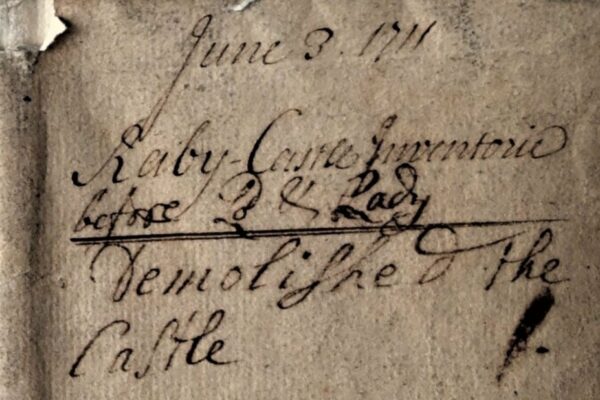
Gilbert successfully sued his father to stop the destruction of his inheritance, with an order in 1716 to repair what had been done. However, when Lord Barnard died in 1723 limited repairs had been undertaken (or none at all), and the castle continued to languish in a largely ruinous state.
In September 1725, Lady Grace married Henry Vane, heir to Gilbert 2nd Lord Barnard. On their marriage, Gilbert settled upon the couple the lands around the castle, perhaps with the hope that they might one day live there. In 1726, Gilbert’s younger brother (who had been the main beneficiary of their father’s will) was sued to complete the repairs on the castle their father had been ordered to undertake.
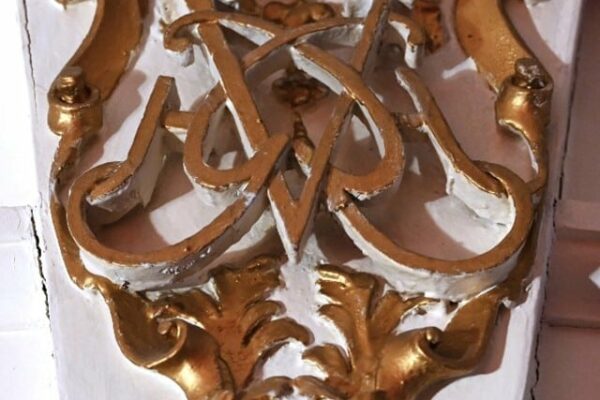
Work began, and a surviving date stone presumably marks the successful completion of the restoration of some or all of the South Range in 1729, with a fragment of the monogram of Henry and Lady Grace. The couple would live at the Castle for around the next 30 years, overseeing its gradual repair and turning it into the fashionable Georgian home, fit for an Earl and Countess (as they would become).
Grace as Administrator, Project Manager, Art Collector
By contemporary accounts, Lady Grace was a formidable woman. Recent research in the archives is beginning to demonstrate that while Grace worked in partnership with her husband, some regarded it as an unequal one. One unsympathetic observer, closely involved with the Vane family at the time, frustratedly remarked that Henry ‘has no notions but what he receives from Lady Grace’.
Grace’s brother, the 3rd Duke of Cleveland & Southampton was widowed in 1742, and he also came to live at Raby for periods of time. Grace became the key administrator between her brother and husband’s financial arrangements, and directed their agents. She used this position, combining the funds of both men to enable the restoration of the castle and development of the parkland around, turning Raby from the semi-ruinous castle in the 1720s into a restored fashionable Georgian country seat by the 1750s.
Grace was far more than just a managerial force. She handled and annotated (and presumably directed) the architectural plans as work progressed. She was also an astute acquirer, commissioner, and creator of artistic works, buying tapestries and paintings to adorn the walls of the castle (some of which still survive).
Lady Grace’s drive and energy to transform the Castle over many decades may have saved it, when after its destruction the Vanes might easily have started afresh elsewhere. When her son inherited Raby in 1758, around three decades after she and Henry had begun their great restoration, the castle was wholly transformed.