
Furnishing the Past | Morel & Hughes and a historic Gothic Interior at Raby Castle
What did the Octagon Drawing Room at Raby Castle look like prior to its development in the mid-1800s? This was the question at the heart of a recent research project undertaken through Raby Castle’s partnership with the Furniture History Society (FHS), helping to mark the 10th anniversary of British and Irish Furniture Makers Online (BIFMO). Funded by the Iris Foundation, two students worked together to investigate the changing history of Raby Castle’s Octagon Drawing Room and to explore evidence of an earlier Gothic-style room that occupied the same space in the early nineteenth century.
Research questions
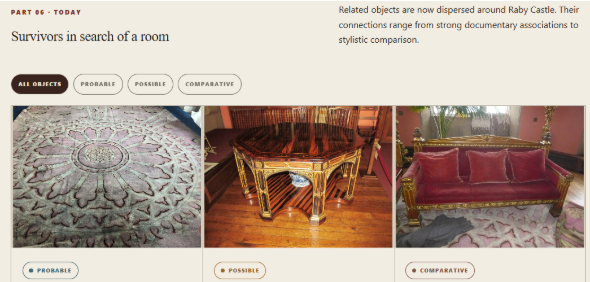
The project initially focused on pieces of furniture attributed to the renowned cabinet-making firm Morel & Hughes, and considered whether they were originally purchased for a historic Gothic Drawing Room at Raby Castle. Emerging archival clues suggested that the furniture may be connected:
- A newspaper report from 1815 described the renovation of a Gothic drawing room at Raby Castle, indicating that significant work was taking place at the time.
- A bill preserved within the NatWest archives from the same year of a significant payment to Morel & Hughes raised the question of whether the furniture was commissioned for the project.
- A Royal Academy catalogue from 1820 references a drawing by R. Hughes, Architect, of a Gothic Drawing Room at Raby Castle. However, no copy of this drawing has yet been identified.
Together, these sources offered a fascinating starting point, while also opening up wider questions about taste, status, design and investment during the Gothic Revival period.