What better way to get to know more about local sights, scenery, history and wildlife than by downloading our fun family activity sheets?
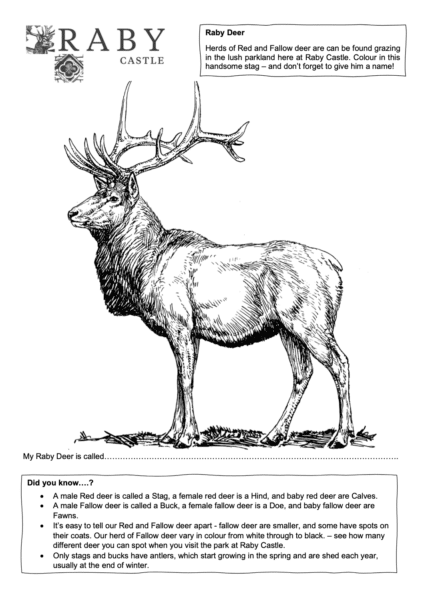
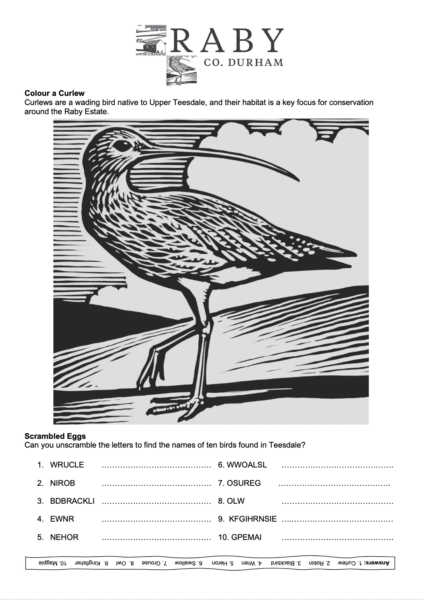
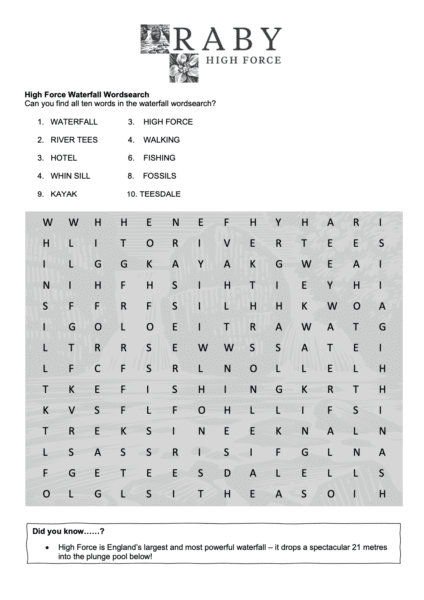
Discover fascinating facts about Raby’s majestic Deer and Upper Teesdale’s graceful Curlews, test your observation skills with our Waterfall Wordsearch and have fun colouring in some of the familiar places and creatures of County Durham.
Our activity sheets are free to download. Simply click on the image to download it in PDF format.
We’d love you to share the link to this page with friends and family.
If you would like to be kept up to date with news, events and activities from Raby Castle and High Force you can sign up to our newsletter here.
We’d love to see pictures of your own creations. Share them with us on Facebook.
Raby Deer Activity Sheet (click image to download)
Curlew Activity Sheet (click image to download)
Waterfall Wordsearch (click image to download)
News
Feature Focus – A Grand Entrance at Raby Castle
As the use of carriages increased from the late 17th Century, the Grand Entrance Hall at Raby Castle underwent a major transformation. In this Feature Focus, our curator Julie Biddlecombe-Brown shares the stories of visitors arriving at Raby’s Grand Entrance, and how this magnificent arrival at Raby Castle has been featured in recent filming at Raby Castle.
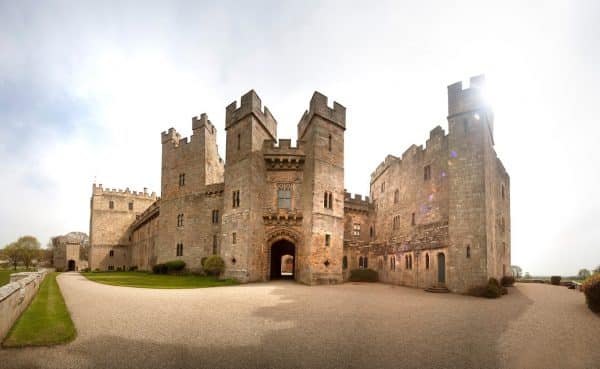
Raby is surely one of the most impressive intact castles in the North of England. Situated near the village of Staindrop in County Durham it was built in the 14th century by the powerful Nevill family. Originally moated and accessed via a drawbridge, the Castle was built as a palace fortress.
The Nevills lived at Raby until 1569 when, after the failure of the Rising of the North, the Castle and its lands were forfeited to the Crown. In 1626, Sir Henry Vane the Elder, Member of Parliament and important member of Charles I’s household, purchased Raby from the Crown. The Vane family still own Raby, the present owner being the 12th Lord Barnard.
Today the stables, coach house, coach and carriage collection are popular with visitors, providing a snapshot of life before the advent of the combustion engine. Before railways, travelling to Raby Castle from London could take four days, with horses being changed every twenty miles. The unpredictable weather of the north-east and the varied condition of the road network meant that long journey could be uncomfortable and potentially dangerous. Visiting the castle in the late 1700s the dramatist George Colman recalled;
“… it rained heavily and incessantly, and we had met with delay, and petty accidents, and vexations, at every turn. In the last seven miles, after sunset, a fog arose; one of the horses cast a shoe, and his rider dismounted to grope for it in the mud and in the dark… we were chilly, hungry, impatient, comfortless, sitting dinnerless in a post-chaise, and waiting the issue of a hunt after a horse-shoe”.
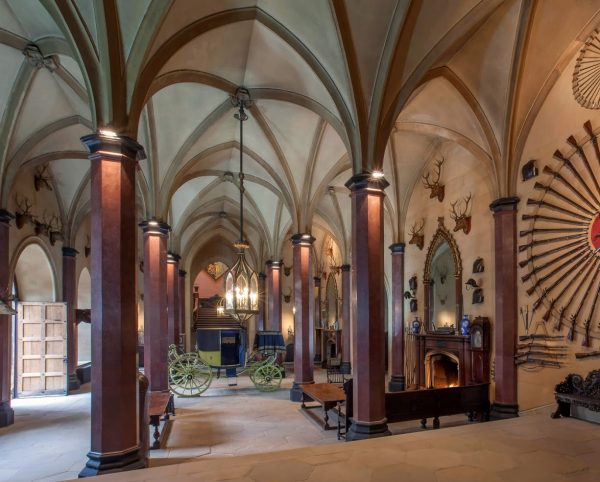
His arrival was a decidedly more cheerful experience as the chaise entered the Castle’s impressive Entrance Hall. Originally a medieval structure, it was adapted by architect John Carr for the 2nd Earl of Darlington to celebrate the coming-of-age of his heir in 1787.
Pevsner describes this alteration to the building as “an unorthodox transformation”. It was driven by the development and increasing use of carriages from the late-17th century. These vehicles had become too large to turn in the castle’s medieval inner courtyard. Rather than enlarge the courtyard, Carr adopted a “drive-through” approach, thereby eliminating the need for turning space. To do this, he created a carriageway that ran right through the Castle’s Grand Entrance Hall, exiting through a gateway below the Chapel. His scheme resulted in significant alterations to the 14th century building; the Barbican was demolished and additional height was achieved in the Entrance Hall by raising the floor of the first-floor Chapel and Barons’ Hall. On the ground floor, Carr created a vaulted ceiling supported by stunning octagonal scagliola pillars.
This transformative scheme made it possible for carriages to drive straight through the hall, eliminating the need to turn in the courtyard and providing an impressive welcome. Picking up on Coleman’s account;
“As we passed through the outer gateway of the Castle the vapour was dense upon the moat, and we were enveloped in the night-fog … but, lo! On the opening of a massive door, a gleam of light flashed upon us: crack went the whips, as we dashed forward at full trot, and in a moment drew up, not to a piazza, nor a vestibule, nor a flight of steps in a cold courtyard, but before a huge blazing fire in a spacious hall. The magical effect of this sudden transition, from destitution to luxury, has never occurred to me anywhere else…”.
His wonder at this lavish and unexpected welcome was echoed by Sally Stevenson. The wife of the American Ambassador was the guest and a good friend of 1st Duke and Duchess of Cleveland. Writing in 1838 she describes,
“…astonished travellers find themselves in a magnificent Gothic Hall, the carriage way passes immediately through it, the roof of which is arched and supported by 6 pillars – on each side of the carriage way … there are two fire-places, and when the Hall is lighted up by 4 large and brilliant chandeliers.
… The carriages & horses with innumerable liveried servants, headed up by the groom of the Chambers, the lights, the splendour and above all the novelty is quite bewildering and makes on almost fancy themselves in an enchanted castle”.
The alterations to provide the ultimate arrival experience were less popular with one of Raby Castle’s later residents. Writing about the Entrance Hall alterations in 1860, the 4th Duchess of Cleveland quips,
“I have said more than enough of the holy horror with which I regard tampering with ancient buildings” although she does concede, “It is such a hospitable welcome to all-comers”.
Raby Castle’s unique entrance was recreated in recent years when the Castle served as a location for filming. In 2016 the ITV television series Victoria saw carriages delivering ‘royal guests’ to the Entrance Hall once more, including actress Jenna Coleman in the title role, experiencing a similar welcome to her 18th century namesake.
The Entrance to Raby Castle through the impressive 14th Century Nevill Gateway led to a small inner courtyard with insufficient space to turn the increasingly impressive coaches and carriages of the 18th century. Rather than enlarge the courtyard, a ‘drive-through’ approach was adopted by the 2nd Earl of Darlington’s architect, John Carr.
The Entrance Hall today still provides a warm welcome for visitors. Here the State Coach built for the Duke of Cleveland c.1810-20 utilised the ‘drive through’ arrangement.
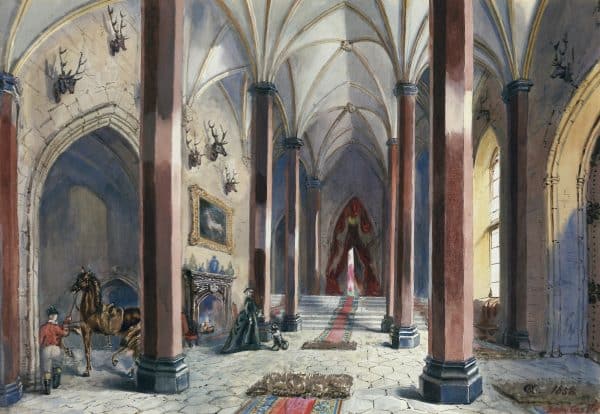
The Entrance Hall at Raby Castle depicted in a watercolour of 1858 shows comfortable carpet runners and a roaring fire to welcome visitors.
Stay up to date with news and events at Raby Castle by signing up to our newsletter
News
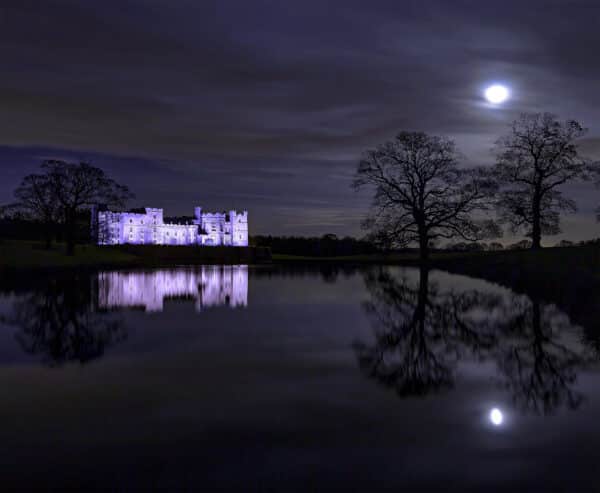
Raby Turns Blue to Support Key Workers
During lockdown the Raby Estate has been turning a different one of its prominent landscapes and buildings blue digitally every Thursday in support of the NHS, Carers and other Key Workers.
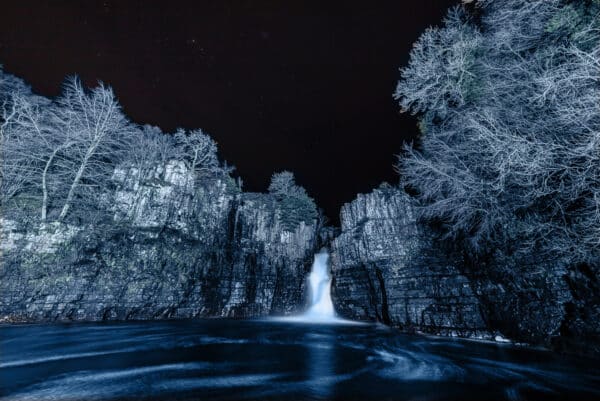
With the help of our friends at Fundamental Design and Marketing we have transformed some of our most iconic images to honour all those who have been working hard throughout the coronavirus crisis to keep us safe.
We have shared images of Raby Castle and High Force Waterfall in County Durham and the Wrekin, which is part of the Raby Estate in Shropshire.
The campaign has been shared by hundreds of people and was featured by Historic Houses as part of their Historic Houses Go Blue campaign.
We have also been actively promoting the government’s message to Stay at Home, Save Lives and Protect the NHS and by turning these images blue digitally and sharing them on our social media channels we are ensuring that everyone can enjoy them from the comfort of their own home without having to go outside.
Missing your trip to Raby or High Force this Spring? Why not have a go at making your own castle or drawing a picture of the Castle or Waterfall at home?
Here is a photo of one created by the children of one of our team to inspire you.
Raby Castle and High Force Waterfall have been painted by many famous artists over the years, including JMW Turner, and now it’s your turn.
We’ll be picking our favourite at the end of May and the winner will receive a Raby Membership for a year. To enter simply send us a message on Facebook with a photo of your artwork.
Raby Castle is missing its visitors. For almost 1000 years the castle has been a hub of activity and a place of welcome. Its owners have included rebellious Knights, influential women, reforming politicians and friends of royalty. The castle has over 120 rooms and just as many mysteries.
We invite you to use your imagination and time at home to take part in our special short story competition. The winner from each category will receive a Raby Membership and shortlisted stories will be published on our website.
Start writing now and submit your story before midnight on Friday 31st May.
The Categories
Age 7-11
Your story can be as silly or sensible as you like. It can be set in the dim and distant past or the mysterious future. It’s completely up to you what you write about and how you tell your tale. All we ask is that it is no longer than 500 words and mentions Raby Castle in some way.
Age 12-17
Use your imagination and create a memorable story. The theme and genre are completely up to you – mystery, sci-fi, drama, comedy or something totally unique and never tried before. Write a maximum of 1,000 words and don’t forget to give Raby Castle a mention.
Age 18+
We invite you to write a story in 2,000 words. Your tale doesn’t have to be about history but we would like you to mention Raby Castle. There is lots of inspiration on our website and we will be sharing regular writing prompts on our Facebook and Instagram over the coming weeks.
How to Enter
The closing date for submission is midnight on Friday 31st May 2020. Entries received after the closing date will not be considered. Early entries much appreciated to give our judges time to enjoy them fully. Online entries only will be accepted.
Please submit your entries by email only to admin@raby.co.uk and type Short Story Competition Entry in the subject box. Please provide your name and which category you are entering in your email. Your story should be supplied as an attachment.
The competition will be judged by members of the Raby Team who will create a shortlist of three stories for each category. The overall winner in each category will receive a Raby Membership. The winners will be announced before 31st July.
By entering this competition you will be agreeing to have your story published on the Raby Castle website if it is shortlisted. For terms and conditions visit https://www.raby.co.uk/competition-terms/
News
Keep a safe distance from the baby deer
During May, June and July, our female deer give birth and although it is very exciting to see babies around the park we always remind our visitors to respect their privacy and keep a safe distance.
If you see a baby deer in the park do not approach it, even if it appears to be on its own. Its mother won’t be too far away and you could be putting the calf and yourself at risk by going too close.
There are a couple of important reasons why mothers and babies should be left alone. Mothers can become aggressive when protecting their young and we would encourage parents to make sure their children are aware of the potential danger so that they don’t approach the young calves.
Another reason for giving the babies plenty of privacy is that their mothers may not return to feed them if they smell human scent near the calf.
Dogs should be kept on a short lead at all times during May, June and July.
If you have any questions about the deer and their young during your visit our staff will be more than happy to help. Just ask one of our team.
New Curator’s Exciting Plans to Explore Raby’s Untold Stories
Raby Castle’s new curator Julie Biddlecombe-Brown cannot wait to uncover some of the untold stories behind the fascinating family collections. Here she tells us about the knowledge she brings to the role and what she is looking forward to most about being part of the Raby team.
How long have you worked as a curator?
I have been a curator since the mid 1990s. Before joining Raby I was exhibitions curator at Durham University, a role I held for 9 years. During my time there we arranged many fascinating exhibitions including the Lindisfarne Gospels in 2013, which was a huge step change for the county and really helped to put our region on the historical map.
Tell us about your first impressions of Raby Castle
I’m a local girl so I grew up in Durham and have driven past the Castle many times. It never fails to take my breath away and I don’t think that sense of wonder will ever wear off. My memories from visiting as a child are dominated by the armoury in the Entrance Hall which really grabbed my attention. I moved back to the North East around 14 years ago after working all over the country and visited the Castle again on a beautiful sunny day. The thing that really struck me then was Raby’s idyllic setting and the vista of the Castle. It is one of the few castles in England where the surroundings are still open and unspoilt and we can see it as it would have been viewed centuries ago.
Do you have a favourite period in history?
Working in exhibitions I have become used to researching many different eras and aspects of history. The thing that matters most is the enthusiasm I can bring to help engage audiences with the stories behind the topics and this is what I really enjoy.
Has anything in particular caught your attention since you arrived at Raby Castle?
I have been really struck by the enthusiasm and passion of the people here. The volunteers and guides are so knowledgeable and they’re fantastic at communicating Raby’s past with the public.
What have you already discovered about Raby’s history?
Pockets of research have been done and there is so much I want to follow up on. I am looking forward to digging around in the archives to uncover more untold stories. One of the things I will be working on is pulling together all the information that already exists into a database so that it is much more accessible.
As you embark on your new role what are your priorities?
The collections are amazing and I can’t wait to find out more about how they came to be at Raby Castle. For every piece of art and every decision made, right down to which wallpaper was chosen for a particular room, there is a story behind it. I am fascinated to find out how and why these things have come into the family collection, whether it was personal taste or fashion, and by exploring these things I hope to shed light on life in the Castle and the people who have lived here over the years. The process of research never stops and by exploring different angles and perspectives we can build a wonderful picture of life at Raby over the centuries.
To find out more about our team at Raby, view our other blogs below, or visit our vacancies page to see our latest opportunities.
Historic Inn at High Force Restored to Former Glory
The High Force Hotel in scenic Upper Teesdale has completed the final phase of a six-month refurbishment programme led by Lady Barnard and designed to enhance its country inn heritage.
Work on the ground floor bar, dining and reception areas was completed during the autumn and introduced traditional framed art prints, period furniture and the Raby Estate tweed to the interior décor scheme. The final phase of the programme completed last week, has transformed the hotel’s six boutique ensuite guest bedrooms, each one individually decorated to include antique pieces of furniture.
Claire Jones, Head of Leisure and Tourism for Raby said; “The High Force Hotel is in such a breathtaking location opposite England’s highest waterfall and within the North Pennines Area of Outstanding Natural Beauty and our ambition has been to create a restful and stylish rural retreat in this very special place.
“We were keen to retain the heritage features of the building, whilst adding modern touches to bathrooms and guest bedrooms, creating a cosy but traditional feel,” she added.
Just a stone’s throw from the magnificent High Force Waterfall and with miles of country walks through
scenic Upper Teesdale on the doorstep, the High Force Hotel is well known for its warm welcome and
wholesome food.
The fully dog friendly hotel is part of the Raby Estates and is run by enthusiastic managers Andrew Lindsay and George Dunn, along with their dog Toby. Andrew and George have been heavily involved in the refurbishment and developing the new menus.
Andrew said: “The new look bar, restaurant and reception areas have gone down really well with customers and we have established quite a reputation as a Sunday lunch destination, with visitors enjoying a stroll across to the waterfall either before or afterwards.
“We have also had excellent feedback from our first overnight guests in our refurbished rooms and we are looking forward to introducing them to more visitors, both old and new over the coming months.”
Senior Guide Shares Magic of Behind the Scenes Tours
Raby Castle’s Behind the Scenes Tours are a chance for visitors to step straight into rooms and corridors from a bygone era and glimpse rooms that have been locked for decades and suspended in time. We caught up with one of our Senior Guides Robert Hillary to discover why these special events are such an enthralling and unique experience and what visitors can expect.
What is different about the Castle’s Behind the Scenes Tours compared to a regular visit to the castle?
Visitors who come on our Behind the Scenes tours are usually quite speechless because they are literally stepping into the past. We go into rooms, stairways and corridors that the public never normally see and many of them have been untouched for years. It’s like waking up in a different age and you can almost sense the servants scurrying past.
Where does the Behind the Scenes tour take people?
Some of the most historic rooms such as the Hunters Gallery and bedrooms were created for the family in the mid 1700s and used during the 1800s but have been barely touched since. They are caught in time and you get a real feel for the lovely lifestyle that they had back in those days. There is such an air of mystery and excitement as we explore these rooms and others that were in regular use until even more recently.
What is your favourite part of the Behind the Scenes tour?
I love the whole place but my absolute favourites on the Behind the Scenes tours are the Billiard Room and the Duke’s Study. Both were frequented by Lord Barnard’s grandfather until his death in 1964 and the study still smells of tobacco when you walk in. As with the other rooms, you can close your eyes and imagine that you are back in the time when it was in regular use. Lord Barnard is keen to open up more of the Castle to the public and I think these tours are probably a sneak preview of some of the magic that awaits visitors in the future.
What can people expect to learn when they visit?
Whether people come for the Behind the Scenes tours or regular tours of the Castle we are able to give them a fascinating insight into Raby’s 1000 year history which began when it was part of the estate of King Canute between 1016 and 1035. One of the great appeals of the Castle is its art collection and when we go Behind the Scenes we have a chance to view many unseen paintings that are not part of the regular tours. The wonderful thing about Raby is that whatever people are interested in – art, silverware, porcelain, furniture, fabrics and history – they can find it here. Visitors love the fact that it is still family owned too.
Why do you love sharing Raby’s stories with visitors?
I was brought up in Barnard Castle so I have grown up with Raby Castle and have always had a fascination with it. I came here regularly as a child and brought my own children here over the years. However, it was when I brought my grandchildren here 12 years ago, just after I had retired, that I rediscovered my passion. I was fortunate that they were looking for guides at the time and I have been here ever since. I love seeing the reaction of visitors when they look around and hear tales from the past. Our visitors are always so fascinated and love to chat and share their own stories about Raby.
Behind the Scenes Tours of the Castle will be back in October.
News
What it’s Like to Volunteer at Raby Castle
Volunteering at Raby Castle can be a rewarding and fascinating hobby and our volunteers play an important role in helping us build a sustainable future for this important historic site.Everyone on the Estate values the important contribution of time and enthusiasm that our volunteers give so generously and we are always pleased to hear about their own positive experiences of being part of the Estate team. We spoke to one of our volunteers Val about why she loves being part of the visitor experience at Raby Castle and how much she’s discovered about its rich history.
Val Fawcett has lived on the doorstep of Raby Castle, in Staindrop village, for many years and has always been fascinated by its history. When she spotted a leaflet in the local shop asking for volunteer stewards she knew it would be the perfect hobby for her.
“Raby is a big part of everyone’s lives around here and I have been a regular visitor over the years but there was so much about its past that I didn’t know, particularly about the family history,” says Val.
Val has a real interest in history and loves visiting cathedrals, churches and historic houses so she was thrilled to have the opportunity to go behind the scenes at Raby and learn all about the castle, its people and its past.
One of the things she remembers most about joining as a volunteer is the warmth of the team and the way she was made to feel welcome at Raby from the very first day.
“Everyone was so friendly and made me feel at ease straightaway,” she says. “The staff and other volunteers are all such lovely people and I really enjoyed getting to know them during training.”
The training itself has given Val a fascinating insight into life at the castle over the centuries.
“We were taken through the castle several times during our training, covering different subjects in detail. We learnt about the furniture, the paintings, the porcelain and much more. I have discovered so much and I am still learning every day. I love sharing some of the facts and stories with visitors and it’s so rewarding to be able to give them a glimpse of the castle’s past and bring its history to life.”
Our volunteer room stewards play an important role in creating an engaging and welcoming visitor experience and Val says she enjoys helping to answer people’s questions. She says she particularly likes the fact that the volunteers move from room to room regularly, which means she can keep refreshing her knowledge of each part of the castle.
“I love all the rooms, there’s something unique and intriguing about all of them, but my absolute favourite is the kitchen. When you stand there and think that it was in continuous daily use for 600 years it’s quite remarkable. It must have been red hot in that room when all four fireplaces were burning.”
Val says she would recommend volunteering at Raby to anyone who is interested in history and being part of a team.
“It’s such a lovely place to be and the more I’m here, the more I learn. I feel involved and part of things, I enjoy chatting to people throughout the day and when I go home I’m full of it.
“If anyone is thinking about volunteering at Raby Castle I recommend they do it – if not, they’ll miss out on a wonderful experience.”